


For many, the concept of movement is strictly tied to the physical act of walking, running or the mechanical rotation of a wheel. But for Radi Charafli, a 28-year-old graphic designer and software engineer based in the UAE, movement is a far more expansive, internal phenomenon.
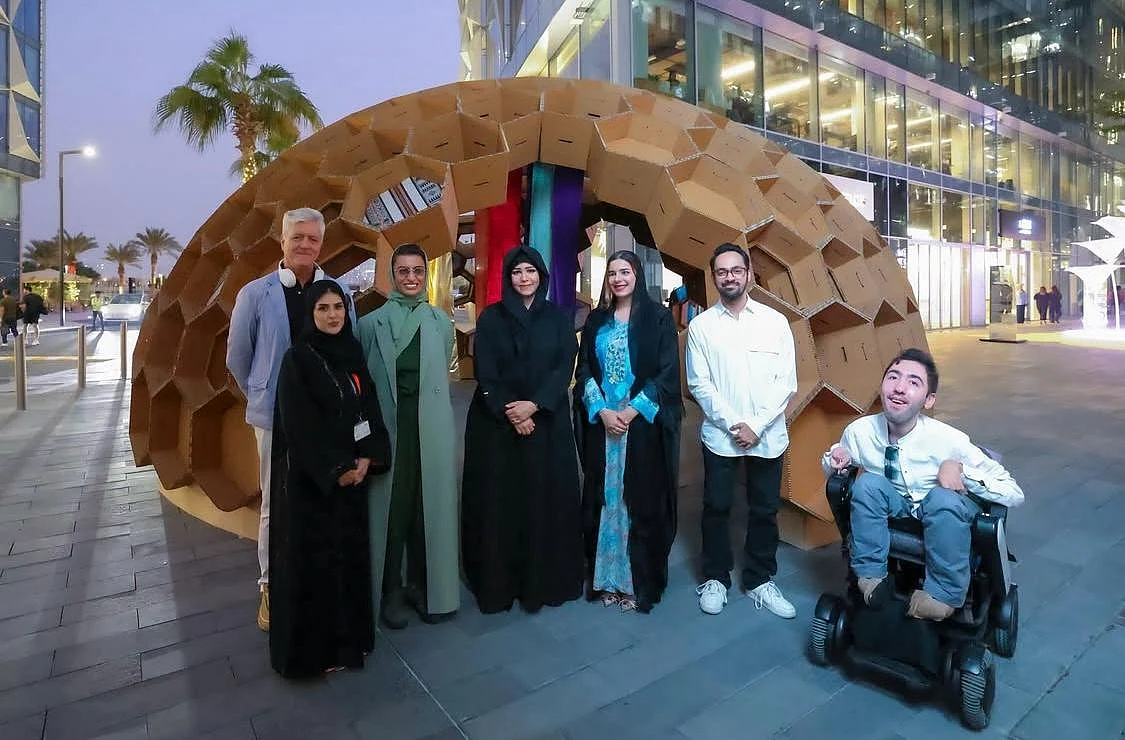
Born with a motor disability, the Syrian artist has spent his life navigating a world that wasn’t always built for him. Yet, rather than seeing his physical limitations as a boundary, Charafli has used them as a catalyst to rethink how we interact with technology and art. Today, he is a key voice in the UAE’s creative landscape, recently serving as a curator and artist for the Dome of Inclusion initiative — a landmark installation that challenged visitors to experience disability through a multi-sensory lens.
A blueprint for unity
A sustainable structure made of interlocking hexagons and pentagons, the Dome of Inclusion was designed to be a “shared vision of creativity,” says Charafli. The geometry itself was symbolic: the hexagons represented six guiding principles — collaboration, creativity, inclusion, empowerment, innovation, and unity — while the pentagons reflected the five key areas of disability, from sensory to neurodiversity.
Working alongside fellow artists of determination Aldana Alhashmi and Ashar Hussain, Charafli transformed the empty structure of the dome into a space that invited visitors to do more than just look. “The project sends a strong message about People of Determination and our abilities,” says Charafli, with a confidence he credits his family for instilling in him from a very young age.

“When I look back at my childhood, it was full of support and love from my family,” Charafli recalls. “They treated me like any other child and never made me feel different. They helped me grow with the belief that my disability is not a barrier to life. At the same time, they expected a lot from me, they asked me about my homework, my responsibilities at home, and my progress.”
This foundation of responsibility allowed him to process his reality without resentment. While he recognised his differences early on, watching cousins and classmates run in the schoolyard, he viewed his situation through the lens of “different abilities” rather than “disability”.
His initial creative outlet was traditional drawing, but as he reached his teenage years, his physical condition began to limit his manual dexterity. At 14, he faced a pivotal choice: abandon art or find a new way to move his brush. He chose the latter, transitioning into the digital realm of Adobe Photoshop and Illustrator.

The digital expression
For Charafli, digital design allowed him to create with a precision that his hands alone could no longer achieve. Now, with over seven years of professional experience across the Middle East and Europe, he views his work as a form of “visual storytelling” that must, by necessity, be accessible. “I wanted my artworks to communicate empowerment,” says Charafli. “I wanted to show that movement and strength are not only physical, they are mental and emotional as well.”
Charafli knew that in a project centred on inclusion, a flat screen or a printed poster was not enough. He advocated for a tactile experience, pushing the boundaries of how his digital vectors could be perceived. “The main challenge for me was translating my digital designs into something physical. I designed the artworks digitally using Photoshop and Illustrator, but the university helped us add 3D-printed elements to the pieces. This allowed visitors — especially those with visual impairments — to touch and feel the artworks.”
Inclusion by design
As a software engineer and designer, Charafli is a strong proponent of “inclusive design” — the idea that accessibility must be baked into the foundation of every product, building, or digital interface from day one. He lives this reality daily, utilising AI and voice commands to navigate his own world.
“I don’t use my phone with my hands. I use voice commands with Siri to make calls or open apps,” he explains. “These tools are essential, and designers need to think about them from the beginning of any project.”
For Charafli, the UAE represents a global leader in this shift. But his personal mission remains focused on the individual: changing the narrative from one of “compliance” to one of “dignity”.
Through his work, he continues to prove that while his body may be anchored to a wheelchair, his creative reach is boundless. To Charafli, the most important movement is the one that happens in the mind of the viewer when they realise that disability is simply another form of human excellence. “I wanted people to physically experience this thought process through art,” he adds. “Art can communicate messages that words sometimes cannot.”
somya@khaleejtimes.com


link